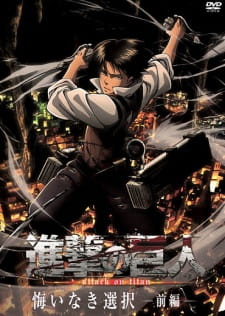
Shingeki no Kyojin: Kuinaki Sentaku
Summary: Many years before becoming the famed captain of the Survey Corps, a young Levi struggles to survive in the capital's garbage dump, the Underground. As the boss of his own criminal operation, Levi attempts to get by with meager earnings while aided by fellow criminals, Isabel Magnolia and Farlan Church. With little hope for the future, Levi accepts a deal from the anti-expedition faction leader Nicholas Lobov, who promises the trio citizenship aboveground if they are able to successfully assassinate Erwin Smith, a squad leader of the Survey Corps.
As Levi and Erwin cross paths, Erwin acknowledges Levi's agility and skill and gives him the option to either become part of the expedition team, or be turned over to the Military Police, to atone for his crimes. Now closer to the man they are tasked to kill, the group plans to complete their mission and save themselves from a grim demise in the dim recesses of their past home. However, they are about to learn that the surface world is not as liberating as they had thought and that sometimes, freedom can come at a heavy price.
Based on the popular spin-off manga of the same name, Shingeki no Kyojin: Kuinaki Sentaku illustrates the encounter between two of Shingeki no Kyojin's pivotal characters, as well as the events of the 23rd expedition beyond the walls.
[Written by MAL Rewrite]
Description
Many years before becoming the famed captain of the Survey Corps, a young Levi struggles to survive in the capital's garbage dump, the Underground. As the boss of his own criminal operation, Levi attempts to get by with meager earnings while aided by fellow criminals, Isabel Magnolia and Farlan Church. With little hope for the future, Levi accepts a deal from the anti-expedition faction leader Nicholas Lobov, who promises the trio citizenship aboveground if they are able to successfully assassinate Erwin Smith, a squad leader of the Survey Corps.
As Levi and Erwin cross paths, Erwin acknowledges Levi's agility and skill and gives him the option to either become part of the expedition team, or be turned over to the Military Police, to atone for his crimes. Now closer to the man they are tasked to kill, the group plans to complete their mission and save themselves from a grim demise in the dim recesses of their past home. However, they are about to learn that the surface world is not as liberating as they had thought and that sometimes, freedom can come at a heavy price.
Based on the popular spin-off manga of the same name, Shingeki no Kyojin: Kuinaki Sentaku illustrates the encounter between two of Shingeki no Kyojin's pivotal characters, as well as the events of the 23rd expedition beyond the walls.
[Written by MAL Rewrite]
Available At
- Array
Shingeki no Kyojin: Kuinaki Sentaku Trailers
Shingeki no Kyojin: Kuinaki Sentaku Pictures
Shingeki no Kyojin: Kuinaki Sentaku Review
Shingeki no Kyojin: Kuinaki Sentaku — Many years before becoming the famed captain of the Survey Corps, a young Levi struggles to survive in the capital's garbage dump, the Underground. This overview is intentionally spoiler-free and focuses on tone and intent rather than plot specifics.
Thematically, It sits firmly within Action conventions as a OVA work and has garnered attention (MAL score: 8.42). This work explores character dynamics, tonal shifts, and the interplay between narrative ambition and execution. The story's pacing and tonal choices are crafted to complement the central ideas, often emphasizing atmosphere and emotional truth over explicit exposition. The show's ability to evoke a consistent mood — whether melancholic, exuberant, or contemplative — is a recurring strength, and the scenes are constructed so viewers can infer stakes without needing explicit spoilers.
Characterization is a core pillar here. Protagonists and supporting figures are written with distinct motivations and narrative roles; even when archetypal, the series invests in small behavioral details that make choices feel earned. Character arcs are handled with an eye for gradualism: development often arrives through incremental beats rather than abrupt, expository shifts. The interactions between characters create texture, and relationships are used to illuminate both personal flaws and larger thematic concerns.
On the visual front, production values play a significant role. The animation quality varies by sequence but frequently showcases thoughtful direction and composition. Background art, framing, and color palettes are used deliberately to support tone — quieter scenes favor muted palettes while action or heightened emotional beats employ brighter, more kinetic visuals. Direction choices, such as camera movement and shot selection, often elevate scenes beyond their raw script, creating moments that linger in the viewer's mind.
The soundscape — score, incidental music, and sound design — complements the visual language. Music cues are placed to maximize emotional resonance without manipulating the audience with melodrama; this restraint often leads to more authentic emotional payoff. Sound design punctuates key moments, and when the series leans on silence, those quieter moments are given weight by measured audio choices.
Pacing and structure are handled with craft. Episodes are arranged to build tension and release methodically, and the narrative rarely rushes through important emotional beats. That said, the deliberate pacing may feel slow to viewers who prefer faster plot turnover; the reward is greater nuance and an accumulation of meaning across the series. Accessibility is generally good — one can appreciate surface-level pleasures, while repeat or attentive viewing reveals additional layers.
No title is without flaws. Occasional unevenness in subplots or variable animation across episodes can be distracting. Some tonal shifts might feel abrupt if you expect uniformity; others will argue that those shifts are purposeful. These are worth noting, but they seldom undercut the larger achievements of the work.
In sum, Shingeki no Kyojin: Kuinaki Sentaku offers a rich experience for viewers who value character-driven storytelling, considered visual design, and a soundtrack that supports rather than overwhelms. For fans of Action, this is an especially rewarding watch. It's recommended for those who appreciate layered narratives and artistry in animation, and best approached with patience and attention to nuance.
Characters & Voice Actors

Church, Farlan
Main
Yusa, Kouji
Japanese
Church, Farlan
Main
Castañeda, Arturo
Spanish
Church, Farlan
Main
Colt Levy, Ryan
English
Church, Farlan
Main
Casemiro, Bruno
Portuguese (BR)

Levi
Main
Kamiya, Hiroshi
Japanese
Levi
Main
Basurto, Alfredo Gabriel
Spanish
Levi
Main
Mercer, Matthew
English
Levi
Main
Sangregório, Bruno
Portuguese (BR)
Levi
Main
Halm, Florian
German

Magnolia, Isabel
Main
Ise, Mariya
Japanese
Magnolia, Isabel
Main
Aguilar, Montserrat
Spanish
Magnolia, Isabel
Main
McGuire, Kristen
English
Magnolia, Isabel
Main
Origuella, Manuela
Portuguese (BR)

Smith, Erwin
Main
Ono, Daisuke
Japanese
Smith, Erwin
Main
Rojas, Octavio
Spanish
Smith, Erwin
Main
Tatum, J. Michael
English
Smith, Erwin
Main
Marques, Guilherme
Portuguese (BR)

Berner, Moblit
Supporting
Velázquez, Ferso
Spanish
Berner, Moblit
Supporting
Nishi, Rintarou
Japanese
Berner, Moblit
Supporting
Jewell, Jerry
English
Staff

Hariu, Masayuki
Producer, Planning

Kawakubo, Shintarou
Producer

Nakatake, Tetsuya
Producer
Sumiya, Kenji
Producer

Araki, Tetsurou
Director, Episode Director, Storyboard

Mima, Masafumi
Sound Director
Itoga, Shintarou
Episode Director

Koizuka, Masashi
Episode Director, Storyboard

Imai, Arifumi
Storyboard, Animation Director, Key Animation

Linked Horizon
Theme Song Performance
Mishima, Souhei
Theme Song Lyrics

Revo
Theme Song Composition, Theme Song Arrangement, Theme Song Lyrics

cinema staff
Theme Song Performance

Anderson, Benjamin
Inserted Song Performance

Asano, Kyouji
Chief Animation Director, Character Design

Dawn-Claude, René
ADR Director

Ebara, Yasuyuki
Key Animation

Isayama, Hajime
Original Character Design, Original Creator

Ishikawa, Mitsuhisa
Executive Producer
Kadokura, Yooko
Assistant Animation Director