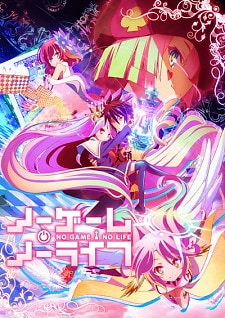
No Game No Life
Summary: Sixteen sentient races inhabit Disboard, a world overseen by Tet, the One True God. The lowest of the sixteen—Imanity—consists of humans, a race with no affinity for magic. In a place where everything is decided through simple games, humankind seems to have no way out of their predicament—but the arrival of two outsiders poses a change.
On Earth, stepsiblings Sora and Shiro are two inseparable shut-ins who dominate various online games under the username "Blank." While notorious on the internet, the pair believe that life is merely another dull game. However, after responding to a message from an unknown user, they are suddenly transported to Disboard. The mysterious sender turns out to be Tet, who informs them about the world's absolute rules. After Tet leaves, Sora and Shiro begin their search for more information and a place to stay, taking them to Elkia—Imanity's only remaining kingdom.
There, the duo encounters Stephanie Dola, an emotional girl vying for the kingdom's sovereignty. In desperation, she attempts to regain her father's throne, but her foolhardiness makes her goal unachievable. Inspired by the girl's motivation and passion, Sora and Shiro decide to aid Stephanie in getting Elkia back on its feet, ultimately aiming to become the new rulers of the enigmatic realm.
[Written by MAL Rewrite]
Description
Sixteen sentient races inhabit Disboard, a world overseen by Tet, the One True God. The lowest of the sixteen—Imanity—consists of humans, a race with no affinity for magic. In a place where everything is decided through simple games, humankind seems to have no way out of their predicament—but the arrival of two outsiders poses a change.
On Earth, stepsiblings Sora and Shiro are two inseparable shut-ins who dominate various online games under the username "Blank." While notorious on the internet, the pair believe that life is merely another dull game. However, after responding to a message from an unknown user, they are suddenly transported to Disboard. The mysterious sender turns out to be Tet, who informs them about the world's absolute rules. After Tet leaves, Sora and Shiro begin their search for more information and a place to stay, taking them to Elkia—Imanity's only remaining kingdom.
There, the duo encounters Stephanie Dola, an emotional girl vying for the kingdom's sovereignty. In desperation, she attempts to regain her father's throne, but her foolhardiness makes her goal unachievable. Inspired by the girl's motivation and passion, Sora and Shiro decide to aid Stephanie in getting Elkia back on its feet, ultimately aiming to become the new rulers of the enigmatic realm.
[Written by MAL Rewrite]
Available At
Warning: Array to string conversion in /home/hianime.me.uk/public_html/anime.php on line 243
Array
Warning: Array to string conversion in /home/hianime.me.uk/public_html/anime.php on line 243
Array
Warning: Array to string conversion in /home/hianime.me.uk/public_html/anime.php on line 243
Array
No Game No Life Trailers
No Game No Life Pictures
No Game No Life Review
No Game No Life — Sixteen sentient races inhabit Disboard, a world overseen by Tet, the One True God. This overview is intentionally spoiler-free and focuses on tone and intent rather than plot specifics.
Thematically, It sits firmly within Comedy, Fantasy, Ecchi conventions as a TV work and has garnered attention (MAL score: 8.04). This work explores character dynamics, tonal shifts, and the interplay between narrative ambition and execution. The story's pacing and tonal choices are crafted to complement the central ideas, often emphasizing atmosphere and emotional truth over explicit exposition. The show's ability to evoke a consistent mood — whether melancholic, exuberant, or contemplative — is a recurring strength, and the scenes are constructed so viewers can infer stakes without needing explicit spoilers.
Characterization is a core pillar here. Protagonists and supporting figures are written with distinct motivations and narrative roles; even when archetypal, the series invests in small behavioral details that make choices feel earned. Character arcs are handled with an eye for gradualism: development often arrives through incremental beats rather than abrupt, expository shifts. The interactions between characters create texture, and relationships are used to illuminate both personal flaws and larger thematic concerns.
On the visual front, production values play a significant role. The animation quality varies by sequence but frequently showcases thoughtful direction and composition. Background art, framing, and color palettes are used deliberately to support tone — quieter scenes favor muted palettes while action or heightened emotional beats employ brighter, more kinetic visuals. Direction choices, such as camera movement and shot selection, often elevate scenes beyond their raw script, creating moments that linger in the viewer's mind.
The soundscape — score, incidental music, and sound design — complements the visual language. Music cues are placed to maximize emotional resonance without manipulating the audience with melodrama; this restraint often leads to more authentic emotional payoff. Sound design punctuates key moments, and when the series leans on silence, those quieter moments are given weight by measured audio choices.
Pacing and structure are handled with craft. Episodes are arranged to build tension and release methodically, and the narrative rarely rushes through important emotional beats. That said, the deliberate pacing may feel slow to viewers who prefer faster plot turnover; the reward is greater nuance and an accumulation of meaning across the series. Accessibility is generally good — one can appreciate surface-level pleasures, while repeat or attentive viewing reveals additional layers.
No title is without flaws. Occasional unevenness in subplots or variable animation across episodes can be distracting. Some tonal shifts might feel abrupt if you expect uniformity; others will argue that those shifts are purposeful. These are worth noting, but they seldom undercut the larger achievements of the work.
In sum, No Game No Life offers a rich experience for viewers who value character-driven storytelling, considered visual design, and a soundtrack that supports rather than overwhelms. For fans of Comedy, Fantasy, Ecchi, this is an especially rewarding watch. It's recommended for those who appreciate layered narratives and artistry in animation, and best approached with patience and attention to nuance.
Characters & Voice Actors

Dola, Stephanie
Main
Hikasa, Youko
Japanese
Dola, Stephanie
Main
Ornelas, Sara
English
Dola, Stephanie
Main
Bau, Eva
Spanish
Dola, Stephanie
Main
Brandes, Winnie
German
Dola, Stephanie
Main
Soares, Clara
French
Dola, Stephanie
Main
Vieira, Jéssica
Portuguese (BR)
Dola, Stephanie
Main
Costanzo, Ruth
Spanish

Shiro
Main
Kayano, Ai
Japanese
Shiro
Main
French, Caitlynn
English
Shiro
Main
Rümmelein, Paulina
German
Shiro
Main
Andrés, Eva
Spanish
Shiro
Main
Bloc, Fanny
French
Shiro
Main
Marie, Jeane
Portuguese (BR)
Shiro
Main
Veppo, Tamara
Spanish
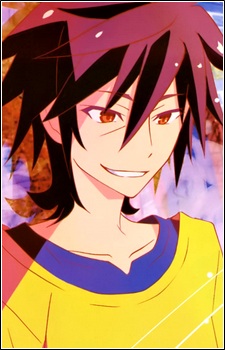
Sora
Main
Matsuoka, Yoshitsugu
Japanese
Sora
Main
Gibbs, Scott
English
Sora
Main
Schalla, Björn
German
Sora
Main
Torrent, Darío
Spanish
Sora
Main
Bourlé, Bastien
French
Sora
Main
Carnevale, Bruno
Portuguese (BR)
Staff

Fukao, Satoshi
Producer
Hayashi, Youhei
Producer
Nakamoto, Kenji
Producer
Shimizu, Mika
Producer

Tanaka, Shou
Producer

Ishizuka, Atsuko
Director, Episode Director, Storyboard

Aketagawa, Jin
Sound Director

Aoki, Hiroyasu
Episode Director

Asaka, Morio
Episode Director, Storyboard
Hosokawa, Hideki
Episode Director, Storyboard

Ikehata, Takashi
Episode Director
Inaba, Yuki
Episode Director
Nakamura, Chikayo
Episode Director
Sasaki, Sumito
Episode Director
Shimizu, Akira
Episode Director
Shiraishi, Michita
Episode Director

Watanabe, Kotono
Episode Director, Storyboard

Aoshima, Takashi
Script

Bickham, Clint
Script

Hanada, Jukki
Script, Series Composition