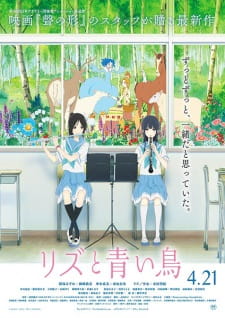
Liz to Aoi Tori
Summary: Liz's days of solitude come to an end when she meets a blue bird in the form of a young girl. Although their relationship blossoms, Liz must make a heart-wrenching decision in order to truly realize her love for Blue Bird.
High school seniors and close friends Mizore Yoroizuka and Nozomi Kasaki are tasked to play the lead instruments in the third movement of Liz and the Blue Bird, a concert band piece inspired by this fairy tale. The introverted and reserved Mizore plays the oboe, representing the kind and gentle Liz. Meanwhile, the radiant and popular Nozomi plays the flute, portraying the cheerful and energetic Blue Bird.
However, as they rehearse, the distance between Mizore and Nozomi seems to grow. Their disjointed duet disappoints the band, and with graduation on the horizon, uncertainty about the future spurs complicated emotions. With little time to improve as their performance draws near, they desperately attempt to connect with their respective characters. But when Mizore and Nozomi consider the story from a brand-new perspective, will the girls find the strength to face harsh realities?
A spin-off film adaptation of the Hibike Euphonium! series, Liz to Aoi Tori dances between the parallels of a charming fairy tale, a moving musical piece, and a delicate high school friendship.
[Written by MAL Rewrite]
Description
Liz's days of solitude come to an end when she meets a blue bird in the form of a young girl. Although their relationship blossoms, Liz must make a heart-wrenching decision in order to truly realize her love for Blue Bird.
High school seniors and close friends Mizore Yoroizuka and Nozomi Kasaki are tasked to play the lead instruments in the third movement of Liz and the Blue Bird, a concert band piece inspired by this fairy tale. The introverted and reserved Mizore plays the oboe, representing the kind and gentle Liz. Meanwhile, the radiant and popular Nozomi plays the flute, portraying the cheerful and energetic Blue Bird.
However, as they rehearse, the distance between Mizore and Nozomi seems to grow. Their disjointed duet disappoints the band, and with graduation on the horizon, uncertainty about the future spurs complicated emotions. With little time to improve as their performance draws near, they desperately attempt to connect with their respective characters. But when Mizore and Nozomi consider the story from a brand-new perspective, will the girls find the strength to face harsh realities?
A spin-off film adaptation of the Hibike Euphonium! series, Liz to Aoi Tori dances between the parallels of a charming fairy tale, a moving musical piece, and a delicate high school friendship.
[Written by MAL Rewrite]
Available At
- Array
Liz to Aoi Tori Trailers
Liz to Aoi Tori Pictures
Liz to Aoi Tori Review
Liz to Aoi Tori — Liz's days of solitude come to an end when she meets a blue bird in the form of a young girl. This overview is intentionally spoiler-free and focuses on tone and intent rather than plot specifics.
Thematically, It sits firmly within Award Winning, Drama conventions as a Movie work and has garnered attention (MAL score: 8.22). This work explores character dynamics, tonal shifts, and the interplay between narrative ambition and execution. The story's pacing and tonal choices are crafted to complement the central ideas, often emphasizing atmosphere and emotional truth over explicit exposition. The show's ability to evoke a consistent mood — whether melancholic, exuberant, or contemplative — is a recurring strength, and the scenes are constructed so viewers can infer stakes without needing explicit spoilers.
Characterization is a core pillar here. Protagonists and supporting figures are written with distinct motivations and narrative roles; even when archetypal, the series invests in small behavioral details that make choices feel earned. Character arcs are handled with an eye for gradualism: development often arrives through incremental beats rather than abrupt, expository shifts. The interactions between characters create texture, and relationships are used to illuminate both personal flaws and larger thematic concerns.
On the visual front, production values play a significant role. The animation quality varies by sequence but frequently showcases thoughtful direction and composition. Background art, framing, and color palettes are used deliberately to support tone — quieter scenes favor muted palettes while action or heightened emotional beats employ brighter, more kinetic visuals. Direction choices, such as camera movement and shot selection, often elevate scenes beyond their raw script, creating moments that linger in the viewer's mind.
The soundscape — score, incidental music, and sound design — complements the visual language. Music cues are placed to maximize emotional resonance without manipulating the audience with melodrama; this restraint often leads to more authentic emotional payoff. Sound design punctuates key moments, and when the series leans on silence, those quieter moments are given weight by measured audio choices.
Pacing and structure are handled with craft. Episodes are arranged to build tension and release methodically, and the narrative rarely rushes through important emotional beats. That said, the deliberate pacing may feel slow to viewers who prefer faster plot turnover; the reward is greater nuance and an accumulation of meaning across the series. Accessibility is generally good — one can appreciate surface-level pleasures, while repeat or attentive viewing reveals additional layers.
No title is without flaws. Occasional unevenness in subplots or variable animation across episodes can be distracting. Some tonal shifts might feel abrupt if you expect uniformity; others will argue that those shifts are purposeful. These are worth noting, but they seldom undercut the larger achievements of the work.
In sum, Liz to Aoi Tori offers a rich experience for viewers who value character-driven storytelling, considered visual design, and a soundtrack that supports rather than overwhelms. For fans of Award Winning, Drama, this is an especially rewarding watch. It's recommended for those who appreciate layered narratives and artistry in animation, and best approached with patience and attention to nuance.
Characters & Voice Actors

Kasaki, Nozomi
Main
Touyama, Nao
Japanese
Kasaki, Nozomi
Main
Sheh, Stephanie
English
Kasaki, Nozomi
Main
Orsat, Alice
French
Kasaki, Nozomi
Main
Nicosia, Roisin
Italian
Kasaki, Nozomi
Main
Laus, Zina
German

Yoroizuka, Mizore
Main
Tanezaki, Atsumi
Japanese
Yoroizuka, Mizore
Main
Hymes, Laurie
English
Yoroizuka, Mizore
Main
Marteddu, Agnese
Italian
Yoroizuka, Mizore
Main
Ziadé, Pauline
French

Aalto
Supporting
Kaneko, Yoshiyuki
Japanese
Aalto
Supporting
Pollock, Mike
English

Hashimoto, Masahiro
Supporting
Nakamura, Yuuichi
Japanese
Hashimoto, Masahiro
Supporting
Pollock, Mike
English
Hashimoto, Masahiro
Supporting
Cavuoto, Francesco
Italian
Hashimoto, Masahiro
Supporting
Paletschek, Jochen
German

Katou, Hazuki
Supporting
Asai, Ayaka
Japanese
Katou, Hazuki
Supporting
Rosenfeld, Alyson
English
Katou, Hazuki
Supporting
Gravina, Benedetta
Italian

Kawashima, Sapphire
Supporting
Toyota, Moe
Japanese
Kawashima, Sapphire
Supporting
Morris, Cassandra Lee
English
Staff

Nakamura, Shinichi
Producer

Saitou, Shigeru
Producer
Senami, Riri
Producer

Yarimizu, Yoshifumi
Producer

Yamada, Naoko
Director, Episode Director, Storyboard, Theme Song Lyrics

Tsuruoka, Youta
Sound Director

Ishihara, Tatsuya
Episode Director

Ogawa, Taichi
Episode Director
Sawa, Shinpei
Episode Director

Takemoto, Yasuhiro
Episode Director

Yoshida, Reiko
Script

Homecomings
Theme Song Performance

Ushio, Kensuke
Theme Song Arrangement, Music
Asama, Hidehiro
Key Animation
Fujita, Naoko
In-Between Animation, Animation Check
Fujita, Takahisa
Production Manager

Gibert, Alexandre
ADR Director
Gotou, Hiroki
Publicity
Hado, Maiko
Key Animation
Hane, Kunihiro
Key Animation