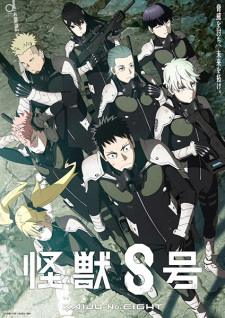
Kaijuu 8-gou
Summary: After the destruction of their hometown, childhood friends Kafka Hibino and Mina Ashiro make a pact to become officers in the Defense Force—a militarized organization tasked with protecting Japan from colossal monsters known as "kaijuu." Decades later, the 32-year-old Kafka has all but given up on his dreams of heroism. Instead, he cleans up the remains of the slaughtered kaijuu after they are defeated by valiant soldiers—including Mina, who has successfully achieved their shared goal.
Upon meeting his new coworker, Reno Ichikawa, Kafka faces a mirror of his past self: an ambitious young man whose one desire is to fight as a member of the Defense Force. Unfortunately, the two are soon involved in a freak encounter with a rogue kaijuu. Though Kafka demonstrates his innate heroic nature and rescues Reno from certain doom, he is left gravely injured.
While both men recover in a hospital, Kafka is seemingly attacked by another one of the beasts. As a result, he gains the ability to transform into a humanoid kaijuu with the strength and powers of the massive monsters menacing Japan. Dubbed "Kaijuu No. 8" by the military, Kafka resolves to use his newfound gifts for the greater good. Tied together by mutual respect, Kafka and Reno set out to join warriors like Mina at the forefront of the Defense Force.
[Written by MAL Rewrite]
Description
After the destruction of their hometown, childhood friends Kafka Hibino and Mina Ashiro make a pact to become officers in the Defense Force—a militarized organization tasked with protecting Japan from colossal monsters known as "kaijuu." Decades later, the 32-year-old Kafka has all but given up on his dreams of heroism. Instead, he cleans up the remains of the slaughtered kaijuu after they are defeated by valiant soldiers—including Mina, who has successfully achieved their shared goal.
Upon meeting his new coworker, Reno Ichikawa, Kafka faces a mirror of his past self: an ambitious young man whose one desire is to fight as a member of the Defense Force. Unfortunately, the two are soon involved in a freak encounter with a rogue kaijuu. Though Kafka demonstrates his innate heroic nature and rescues Reno from certain doom, he is left gravely injured.
While both men recover in a hospital, Kafka is seemingly attacked by another one of the beasts. As a result, he gains the ability to transform into a humanoid kaijuu with the strength and powers of the massive monsters menacing Japan. Dubbed "Kaijuu No. 8" by the military, Kafka resolves to use his newfound gifts for the greater good. Tied together by mutual respect, Kafka and Reno set out to join warriors like Mina at the forefront of the Defense Force.
[Written by MAL Rewrite]
Available At
- Array
- Array
- Array
Kaijuu 8-gou Trailers
Kaijuu 8-gou Pictures
Kaijuu 8-gou Review
Kaijuu 8-gou — After the destruction of their hometown, childhood friends Kafka Hibino and Mina Ashiro make a pact to become officers in the Defense Force—a militarized organization tasked with protecting Japan from colossal monsters known as "kaijuu." Decades later, the 32-year-old Kafka has all but given up on his dreams of heroism. This overview is intentionally spoiler-free and focuses on tone and intent rather than plot specifics.
Thematically, It sits firmly within Action, Fantasy, Sci-Fi conventions as a TV work and has garnered attention (MAL score: 8.26). This work explores character dynamics, tonal shifts, and the interplay between narrative ambition and execution. The story's pacing and tonal choices are crafted to complement the central ideas, often emphasizing atmosphere and emotional truth over explicit exposition. The show's ability to evoke a consistent mood — whether melancholic, exuberant, or contemplative — is a recurring strength, and the scenes are constructed so viewers can infer stakes without needing explicit spoilers.
Characterization is a core pillar here. Protagonists and supporting figures are written with distinct motivations and narrative roles; even when archetypal, the series invests in small behavioral details that make choices feel earned. Character arcs are handled with an eye for gradualism: development often arrives through incremental beats rather than abrupt, expository shifts. The interactions between characters create texture, and relationships are used to illuminate both personal flaws and larger thematic concerns.
On the visual front, production values play a significant role. The animation quality varies by sequence but frequently showcases thoughtful direction and composition. Background art, framing, and color palettes are used deliberately to support tone — quieter scenes favor muted palettes while action or heightened emotional beats employ brighter, more kinetic visuals. Direction choices, such as camera movement and shot selection, often elevate scenes beyond their raw script, creating moments that linger in the viewer's mind.
The soundscape — score, incidental music, and sound design — complements the visual language. Music cues are placed to maximize emotional resonance without manipulating the audience with melodrama; this restraint often leads to more authentic emotional payoff. Sound design punctuates key moments, and when the series leans on silence, those quieter moments are given weight by measured audio choices.
Pacing and structure are handled with craft. Episodes are arranged to build tension and release methodically, and the narrative rarely rushes through important emotional beats. That said, the deliberate pacing may feel slow to viewers who prefer faster plot turnover; the reward is greater nuance and an accumulation of meaning across the series. Accessibility is generally good — one can appreciate surface-level pleasures, while repeat or attentive viewing reveals additional layers.
No title is without flaws. Occasional unevenness in subplots or variable animation across episodes can be distracting. Some tonal shifts might feel abrupt if you expect uniformity; others will argue that those shifts are purposeful. These are worth noting, but they seldom undercut the larger achievements of the work.
In sum, Kaijuu 8-gou offers a rich experience for viewers who value character-driven storytelling, considered visual design, and a soundtrack that supports rather than overwhelms. For fans of Action, Fantasy, Sci-Fi, this is an especially rewarding watch. It's recommended for those who appreciate layered narratives and artistry in animation, and best approached with patience and attention to nuance.
Characters & Voice Actors

Hibino, Kafka
Main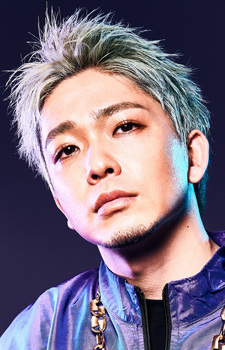
Fukunishi, Masaya
Japanese
Hibino, Kafka
Main
Tarsha, Nazeeh H.
English
Hibino, Kafka
Main
Tipton, Alexis
English
Hibino, Kafka
Main
Santhos, Leonardo
Portuguese (BR)
Hibino, Kafka
Main
Antoine, Adrien
French
Hibino, Kafka
Main
Bressan, Mattia
Italian
Hibino, Kafka
Main
Han, Megumi
Japanese
Hibino, Kafka
Main
Darazi, Estelle
French
Hibino, Kafka
Main
Sánchez, Omar
Spanish
Hibino, Kafka
Main
Tamburrini, Sebastiano
Italian
Hibino, Kafka
Main
Kamin, Felix
German

Hoshina, Soushirou
Main
Kawanishi, Kengo
Japanese
Hoshina, Soushirou
Main
McDonald, Landon
English
Hoshina, Soushirou
Main
Gesteira, Yan
Portuguese (BR)
Hoshina, Soushirou
Main
Prévost, Jérémy
French
Hoshina, Soushirou
Main
Coronel, Bruno
Spanish
Hoshina, Soushirou
Main
Petrick, Dirk
German
Hoshina, Soushirou
Main
Di Benedetto, Massimo
Italian
Hoshina, Soushirou
Main
Felis, Rubén
Spanish

Ichikawa, Reno
Main
Katou, Wataru
Japanese
Staff
Arita, Takemasa
Producer
Hashimoto, Ryuu
Producer
Hayashi, Tatsurou
Producer, Planning

Morihiro, Fumi
Producer

Ohira, Masashi
Producer
Okajima, Takatoshi
Producer

Takei, Katsuhiro
Producer, Planning
Yanagisawa, Shunsuke
Producer
Endou, Ami
Assistant Producer
Hoonoki, Chiharu
Assistant Producer
Kitamura, Kei
Assistant Producer
Takeuchi, Moeka
Assistant Producer

Kamiya, Tomomi
Director, Episode Director, Storyboard

Miya, Shigeyuki
Director, Storyboard

Gou, Fumiyuki
Sound Director
Abe, Masamitsu
Episode Director
Ezoe, Hitomi
Episode Director
Furukawa, Ryouta
Episode Director, Storyboard, Animation Director

Ibata, Yoshihide
Episode Director

Inagaki, Takayuki
Episode Director