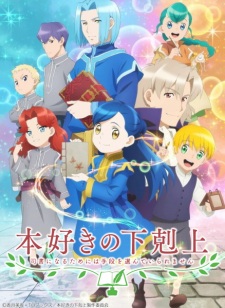
Honzuki no Gekokujou: Shisho ni Naru Tame ni wa Shudan wo Erandeiraremasen 2nd Season
Summary: When Myne learns that the Holy Church is in need of mana for their relics, she sees it as her chance to be cured of her life-threatening mana disorder. After seeing their bountiful library, she throws herself headfirst into the Church's grasp and begs to join their order. In exchange for her service and her unusually bountiful supply of mana, Myne is given the blue robes of a noble-born apprentice priestess, despite being a commoner. To Myne, all this talk of mana and nobility is trivial, as she now has access to an unlimited supply of books!
As Myne transitions into the next phase of her life in this new world, she soon learns that achieving her dream has come at a heavy cost. Noble society is severe, unforgiving, and fueled by politics and neglect. She must now deal with the class conflict between the noble-born blue robes and the common-born grey robes, the High Priest's attempts to oust her, and constant behavioral issues from her new retainers. With the help of her family, friends, and the enigmatic Head Priest whose loyalties and motives remain unknown, Myne seeks to overcome these obstacles and continue on the path to becoming her ideal self—the ultimate librarian!
[Written by MAL Rewrite]
Description
When Myne learns that the Holy Church is in need of mana for their relics, she sees it as her chance to be cured of her life-threatening mana disorder. After seeing their bountiful library, she throws herself headfirst into the Church's grasp and begs to join their order. In exchange for her service and her unusually bountiful supply of mana, Myne is given the blue robes of a noble-born apprentice priestess, despite being a commoner. To Myne, all this talk of mana and nobility is trivial, as she now has access to an unlimited supply of books!
As Myne transitions into the next phase of her life in this new world, she soon learns that achieving her dream has come at a heavy cost. Noble society is severe, unforgiving, and fueled by politics and neglect. She must now deal with the class conflict between the noble-born blue robes and the common-born grey robes, the High Priest's attempts to oust her, and constant behavioral issues from her new retainers. With the help of her family, friends, and the enigmatic Head Priest whose loyalties and motives remain unknown, Myne seeks to overcome these obstacles and continue on the path to becoming her ideal self—the ultimate librarian!
[Written by MAL Rewrite]
Available At
Warning: Array to string conversion in /home/hianime.me.uk/public_html/anime.php on line 243
Array
Honzuki no Gekokujou: Shisho ni Naru Tame ni wa Shudan wo Erandeiraremasen 2nd Season Trailers
Honzuki no Gekokujou: Shisho ni Naru Tame ni wa Shudan wo Erandeiraremasen 2nd Season Pictures
Honzuki no Gekokujou: Shisho ni Naru Tame ni wa Shudan wo Erandeiraremasen 2nd Season Review
Honzuki no Gekokujou: Shisho ni Naru Tame ni wa Shudan wo Erandeiraremasen 2nd Season — When Myne learns that the Holy Church is in need of mana for their relics, she sees it as her chance to be cured of her life-threatening mana disorder. This overview is intentionally spoiler-free and focuses on tone and intent rather than plot specifics.
Thematically, It sits firmly within Fantasy conventions as a TV work and has garnered attention (MAL score: 8.08). This work explores character dynamics, tonal shifts, and the interplay between narrative ambition and execution. The story's pacing and tonal choices are crafted to complement the central ideas, often emphasizing atmosphere and emotional truth over explicit exposition. The show's ability to evoke a consistent mood — whether melancholic, exuberant, or contemplative — is a recurring strength, and the scenes are constructed so viewers can infer stakes without needing explicit spoilers.
Characterization is a core pillar here. Protagonists and supporting figures are written with distinct motivations and narrative roles; even when archetypal, the series invests in small behavioral details that make choices feel earned. Character arcs are handled with an eye for gradualism: development often arrives through incremental beats rather than abrupt, expository shifts. The interactions between characters create texture, and relationships are used to illuminate both personal flaws and larger thematic concerns.
On the visual front, production values play a significant role. The animation quality varies by sequence but frequently showcases thoughtful direction and composition. Background art, framing, and color palettes are used deliberately to support tone — quieter scenes favor muted palettes while action or heightened emotional beats employ brighter, more kinetic visuals. Direction choices, such as camera movement and shot selection, often elevate scenes beyond their raw script, creating moments that linger in the viewer's mind.
The soundscape — score, incidental music, and sound design — complements the visual language. Music cues are placed to maximize emotional resonance without manipulating the audience with melodrama; this restraint often leads to more authentic emotional payoff. Sound design punctuates key moments, and when the series leans on silence, those quieter moments are given weight by measured audio choices.
Pacing and structure are handled with craft. Episodes are arranged to build tension and release methodically, and the narrative rarely rushes through important emotional beats. That said, the deliberate pacing may feel slow to viewers who prefer faster plot turnover; the reward is greater nuance and an accumulation of meaning across the series. Accessibility is generally good — one can appreciate surface-level pleasures, while repeat or attentive viewing reveals additional layers.
No title is without flaws. Occasional unevenness in subplots or variable animation across episodes can be distracting. Some tonal shifts might feel abrupt if you expect uniformity; others will argue that those shifts are purposeful. These are worth noting, but they seldom undercut the larger achievements of the work.
In sum, Honzuki no Gekokujou: Shisho ni Naru Tame ni wa Shudan wo Erandeiraremasen 2nd Season offers a rich experience for viewers who value character-driven storytelling, considered visual design, and a soundtrack that supports rather than overwhelms. For fans of Fantasy, this is an especially rewarding watch. It's recommended for those who appreciate layered narratives and artistry in animation, and best approached with patience and attention to nuance.
Characters & Voice Actors

Ferdinand
Main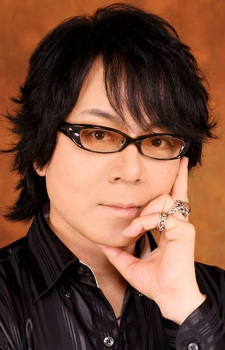
Hayami, Show
Japanese
Ferdinand
Main
Taylor, Armen
English

Lutz
Main
Tamura, Mutsumi
Japanese
Lutz
Main
Tirado, Jeannie
English
Lutz
Main
Rodríguez Ramírez, Ángel Iván
Spanish

Myne
Main
Iguchi, Yuka
Japanese
Myne
Main
Buhr, Reba
English

Benno
Supporting
Koyasu, Takehito
Japanese
Benno
Supporting
Mobus, Xander
English

Bezewanst
Supporting
Hoshino, Mitsuaki
Japanese
Bezewanst
Supporting
Chalmers, Brook
English

Corinna
Supporting
Kinugawa, Rika
Japanese
Corinna
Supporting
Harlacher, Erika
English

Delia
Supporting
Tomaru, Chiyo
Japanese
Delia
Supporting
Freeman, Lizzie
English

Egmont
Supporting
Ella
Supporting
Eva
Supporting
Orikasa, Fumiko
Japanese
Eva
Supporting
Day, Kirsten
English

Fran
Supporting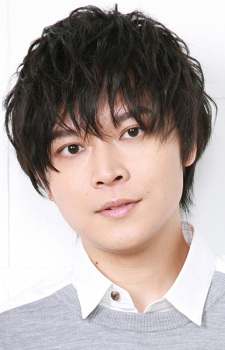
Karino, Shou
Japanese
Staff

Hongou, Mitsuru
Director, Episode Director

Watanabe, Jun
Sound Director

Kase, Mitsuko
Episode Director
Kawasaki, Yoshiki
Episode Director, Storyboard, Assistant Director
Nakamura, Chikayo
Episode Director
Ogata, Takahide
Episode Director, Storyboard

Ueda, Shigeru
Episode Director, Storyboard
Kunisawa, Mariko
Script, Series Composition

Mori, Takeshi
Storyboard

Morohoshi, Sumire
Theme Song Performance

Shirato, Yuusuke
Theme Song Arrangement, Theme Song Composition

Suzuki, Minori
Theme Song Performance
Amada, Toshiki
Background Art
Chibayama, Natsue
Key Animation
Endou, Emiko
Animation Director, 2nd Key Animation, Chief Animation Director, Key Animation

Endou, Kenichi
Chief Animation Director
Endou, Kaori
Key Animation
Enomoto, Katsunori
Key Animation
Horikoshi, Yumi
Background Art
Hoshino, Taku
Key Animation