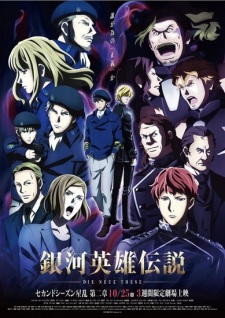
Ginga Eiyuu Densetsu: Die Neue These - Seiran 2
Summary: Marquis Reinhard von Lohengramm's plot to destabilize the Free Planets Alliance succeeds when the treacherous former Rear Admiral Arthur Lynch instigates a coup on Heinessen. Equipped with a plan crafted by Reinhard himself, Lynch encourages his longtime friend Admiral Dwight Greenhill to supervise the National Salvation Military Council's toppling of the civilian government. Seeking to defend democracy and restore the Alliance constitution, Admiral Yang Wen-li faces off against his fellow citizens—and, regrettably, the father of his devoted adjutant Lieutenant Frederica Greenhill.
Now with the Free Planets Alliance thoroughly occupied with their own internal matters, the forces of the Galactic Empire can safely suppress the newly formed Lippstadt League led by Duke Otto von Braunschweig. However, with his friend and loyal subordinate High Admiral Siegfried Kircheis fighting far away in the noble-controlled frontier regions, Reinhard increasingly relies on the advice of the ruthless Vice Admiral Paul von Oberstein, whose influence within the esteemed Lohengramm admiralty steadily grows.
Though bloodshed is inevitable on both sides of the galaxy, Yang Wen-li of the Alliance and Reinhard von Lohengramm of the Empire each ask themselves the same questions: how will history look back on their actions? Will the ends justify the means?
[Written by MAL Rewrite]
Description
Marquis Reinhard von Lohengramm's plot to destabilize the Free Planets Alliance succeeds when the treacherous former Rear Admiral Arthur Lynch instigates a coup on Heinessen. Equipped with a plan crafted by Reinhard himself, Lynch encourages his longtime friend Admiral Dwight Greenhill to supervise the National Salvation Military Council's toppling of the civilian government. Seeking to defend democracy and restore the Alliance constitution, Admiral Yang Wen-li faces off against his fellow citizens—and, regrettably, the father of his devoted adjutant Lieutenant Frederica Greenhill.
Now with the Free Planets Alliance thoroughly occupied with their own internal matters, the forces of the Galactic Empire can safely suppress the newly formed Lippstadt League led by Duke Otto von Braunschweig. However, with his friend and loyal subordinate High Admiral Siegfried Kircheis fighting far away in the noble-controlled frontier regions, Reinhard increasingly relies on the advice of the ruthless Vice Admiral Paul von Oberstein, whose influence within the esteemed Lohengramm admiralty steadily grows.
Though bloodshed is inevitable on both sides of the galaxy, Yang Wen-li of the Alliance and Reinhard von Lohengramm of the Empire each ask themselves the same questions: how will history look back on their actions? Will the ends justify the means?
[Written by MAL Rewrite]
Ginga Eiyuu Densetsu: Die Neue These - Seiran 2 Trailers
Ginga Eiyuu Densetsu: Die Neue These - Seiran 2 Pictures
Ginga Eiyuu Densetsu: Die Neue These - Seiran 2 Review
Ginga Eiyuu Densetsu: Die Neue These - Seiran 2 — Marquis Reinhard von Lohengramm's plot to destabilize the Free Planets Alliance succeeds when the treacherous former Rear Admiral Arthur Lynch instigates a coup on Heinessen. This overview is intentionally spoiler-free and focuses on tone and intent rather than plot specifics.
Thematically, It sits firmly within Drama, Sci-Fi conventions as a Movie work and has garnered attention (MAL score: 8.17). This work explores character dynamics, tonal shifts, and the interplay between narrative ambition and execution. The story's pacing and tonal choices are crafted to complement the central ideas, often emphasizing atmosphere and emotional truth over explicit exposition. The show's ability to evoke a consistent mood — whether melancholic, exuberant, or contemplative — is a recurring strength, and the scenes are constructed so viewers can infer stakes without needing explicit spoilers.
Characterization is a core pillar here. Protagonists and supporting figures are written with distinct motivations and narrative roles; even when archetypal, the series invests in small behavioral details that make choices feel earned. Character arcs are handled with an eye for gradualism: development often arrives through incremental beats rather than abrupt, expository shifts. The interactions between characters create texture, and relationships are used to illuminate both personal flaws and larger thematic concerns.
On the visual front, production values play a significant role. The animation quality varies by sequence but frequently showcases thoughtful direction and composition. Background art, framing, and color palettes are used deliberately to support tone — quieter scenes favor muted palettes while action or heightened emotional beats employ brighter, more kinetic visuals. Direction choices, such as camera movement and shot selection, often elevate scenes beyond their raw script, creating moments that linger in the viewer's mind.
The soundscape — score, incidental music, and sound design — complements the visual language. Music cues are placed to maximize emotional resonance without manipulating the audience with melodrama; this restraint often leads to more authentic emotional payoff. Sound design punctuates key moments, and when the series leans on silence, those quieter moments are given weight by measured audio choices.
Pacing and structure are handled with craft. Episodes are arranged to build tension and release methodically, and the narrative rarely rushes through important emotional beats. That said, the deliberate pacing may feel slow to viewers who prefer faster plot turnover; the reward is greater nuance and an accumulation of meaning across the series. Accessibility is generally good — one can appreciate surface-level pleasures, while repeat or attentive viewing reveals additional layers.
No title is without flaws. Occasional unevenness in subplots or variable animation across episodes can be distracting. Some tonal shifts might feel abrupt if you expect uniformity; others will argue that those shifts are purposeful. These are worth noting, but they seldom undercut the larger achievements of the work.
In sum, Ginga Eiyuu Densetsu: Die Neue These - Seiran 2 offers a rich experience for viewers who value character-driven storytelling, considered visual design, and a soundtrack that supports rather than overwhelms. For fans of Drama, Sci-Fi, this is an especially rewarding watch. It's recommended for those who appreciate layered narratives and artistry in animation, and best approached with patience and attention to nuance.
Characters & Voice Actors

Kircheis, Siegfried
Main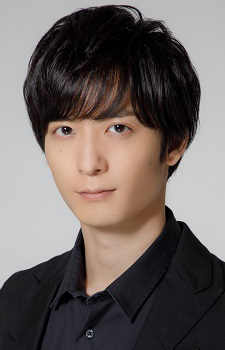
Umehara, Yuuichirou
Japanese
Kircheis, Siegfried
Main
Strobl, Amadeus
German

von Lohengramm, Reinhard
Main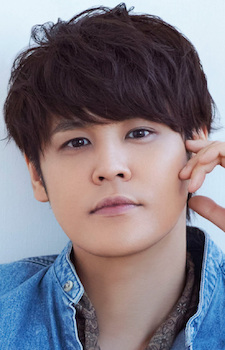
Miyano, Mamoru
Japanese
von Lohengramm, Reinhard
Main
Dismuke, Aaron
Japanese

Yang, Wen-li
Main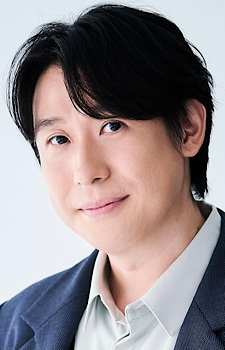
Suzumura, Kenichi
Japanese
Yang, Wen-li
Main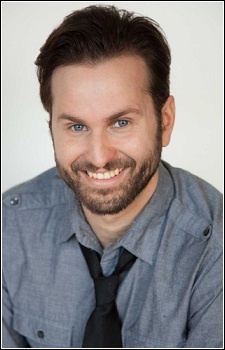
Sinclair, Ian
English

Ansbach
Supporting
Touchi, Hiroki
Japanese

Armsdorf
Supporting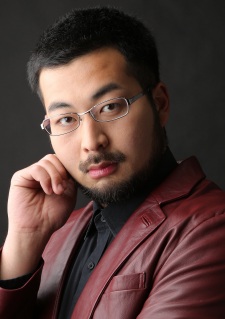
Sumi, Takahiro
Japanese

Attenborough, Dusty
Supporting
Ishikawa, Kaito
Japanese
Attenborough, Dusty
Supporting
Schwarzmaier, Tim
German

Baghdash
Supporting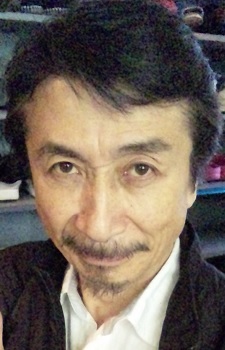
Ushiyama, Shigeru
Japanese

Bergengrün, Hans Eduard
Supporting
Hiwatari, Koji
Japanese

Blumhardt, Rainer
Supporting
Mogami, Tsuguo
Japanese

Bronze
Supporting
Takaguchi, Kousuke
Japanese

Bucock, Alexander
Supporting
Ishihara, Bon
Japanese

Cazellnu, Alex
Supporting
Kawashima, Tokuyoshi
Japanese

Christian
Supporting
Endou, Daichi
Japanese

Dawson
Supporting
Kuroda, Takaya
Japanese
Dawson
Supporting
McAlister, Patrick
English

Edwards, Jessica
Supporting
Kinoshita, Sayaka
Japanese
Staff

Cook, Justin
Producer

Isobe, Maaya
Producer

Kuroki, Rui
Producer

Tasaka, Hidemasa
Producer

Herek, Samantha
Assistant Producer

Tada, Shunsuke
Director

Mima, Masafumi
Sound Director
Andou, Takashi
Episode Director
Iiyama, Nahoko
Episode Director
Matsuzawa, Kenichi
Episode Director
Ogasawara, Kazuma
Episode Director
Itadaki, Shinji
Storyboard, Key Animation

Anderson, Benjamin
Theme Song Lyrics

Anly
Theme Song Performance

Sawano, Hiroyuki
Theme Song Arrangement, Theme Song Composition

Uru
Theme Song Performance

mpi
Theme Song Lyrics

Arai, Eiji
Director of Photography
Fujimaki, Ren
Key Animation, 2nd Key Animation

Gotou, Takayuki
Chief Animation Director