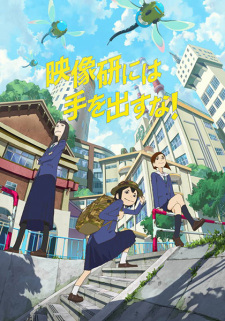
Eizouken ni wa Te wo Dasu na!
Summary: Midori Asakusa sees the world a bit differently. Always having her nose in a sketchbook, Asakusa draws detailed landscapes and backgrounds of both the world around her and the one within her boundless imagination. Even the simple act of doodling on a wall evolves into an emergency repair on the outer hull of her spaceship. She is only brought back to reality by her best friend Sayaka Kanamori. The pair are stark opposites, with Asakusa's childlike wonder contrasted by Kanamori's calculated approach to life.
After a chance encounter where the two "save" the young model Tsubame Misuzaki from her overprotective bodyguard, a connection instantly sparks between Asakusa and Misuzaki, as both share an intense passion for art and animation. Whereas Asakusa is interested in backgrounds and settings, Misuzaki loves drawing the human form. Sensing a money-making opportunity, Kanamori suggests that they start an animation club, which they disguise as a motion picture club since the school already has an anime club. Thus begins the trio's journey of producing animation that will awe the world.
From the brilliant mind of Masaaki Yuasa, Eizouken ni wa Te wo Dasu na! is a love letter to animation, wildly creative in its approach, and a testament to the potential of the medium.
[Written by MAL Rewrite]
Description
Midori Asakusa sees the world a bit differently. Always having her nose in a sketchbook, Asakusa draws detailed landscapes and backgrounds of both the world around her and the one within her boundless imagination. Even the simple act of doodling on a wall evolves into an emergency repair on the outer hull of her spaceship. She is only brought back to reality by her best friend Sayaka Kanamori. The pair are stark opposites, with Asakusa's childlike wonder contrasted by Kanamori's calculated approach to life.
After a chance encounter where the two "save" the young model Tsubame Misuzaki from her overprotective bodyguard, a connection instantly sparks between Asakusa and Misuzaki, as both share an intense passion for art and animation. Whereas Asakusa is interested in backgrounds and settings, Misuzaki loves drawing the human form. Sensing a money-making opportunity, Kanamori suggests that they start an animation club, which they disguise as a motion picture club since the school already has an anime club. Thus begins the trio's journey of producing animation that will awe the world.
From the brilliant mind of Masaaki Yuasa, Eizouken ni wa Te wo Dasu na! is a love letter to animation, wildly creative in its approach, and a testament to the potential of the medium.
[Written by MAL Rewrite]
Available At
- Array
- Array
Eizouken ni wa Te wo Dasu na! Trailers
Eizouken ni wa Te wo Dasu na! Pictures
Eizouken ni wa Te wo Dasu na! Review
Eizouken ni wa Te wo Dasu na! — Midori Asakusa sees the world a bit differently. This overview is intentionally spoiler-free and focuses on tone and intent rather than plot specifics.
Thematically, It sits firmly within Adventure, Award Winning, Comedy conventions as a TV work and has garnered attention (MAL score: 8.13). This work explores character dynamics, tonal shifts, and the interplay between narrative ambition and execution. The story's pacing and tonal choices are crafted to complement the central ideas, often emphasizing atmosphere and emotional truth over explicit exposition. The show's ability to evoke a consistent mood — whether melancholic, exuberant, or contemplative — is a recurring strength, and the scenes are constructed so viewers can infer stakes without needing explicit spoilers.
Characterization is a core pillar here. Protagonists and supporting figures are written with distinct motivations and narrative roles; even when archetypal, the series invests in small behavioral details that make choices feel earned. Character arcs are handled with an eye for gradualism: development often arrives through incremental beats rather than abrupt, expository shifts. The interactions between characters create texture, and relationships are used to illuminate both personal flaws and larger thematic concerns.
On the visual front, production values play a significant role. The animation quality varies by sequence but frequently showcases thoughtful direction and composition. Background art, framing, and color palettes are used deliberately to support tone — quieter scenes favor muted palettes while action or heightened emotional beats employ brighter, more kinetic visuals. Direction choices, such as camera movement and shot selection, often elevate scenes beyond their raw script, creating moments that linger in the viewer's mind.
The soundscape — score, incidental music, and sound design — complements the visual language. Music cues are placed to maximize emotional resonance without manipulating the audience with melodrama; this restraint often leads to more authentic emotional payoff. Sound design punctuates key moments, and when the series leans on silence, those quieter moments are given weight by measured audio choices.
Pacing and structure are handled with craft. Episodes are arranged to build tension and release methodically, and the narrative rarely rushes through important emotional beats. That said, the deliberate pacing may feel slow to viewers who prefer faster plot turnover; the reward is greater nuance and an accumulation of meaning across the series. Accessibility is generally good — one can appreciate surface-level pleasures, while repeat or attentive viewing reveals additional layers.
No title is without flaws. Occasional unevenness in subplots or variable animation across episodes can be distracting. Some tonal shifts might feel abrupt if you expect uniformity; others will argue that those shifts are purposeful. These are worth noting, but they seldom undercut the larger achievements of the work.
In sum, Eizouken ni wa Te wo Dasu na! offers a rich experience for viewers who value character-driven storytelling, considered visual design, and a soundtrack that supports rather than overwhelms. For fans of Adventure, Award Winning, Comedy, this is an especially rewarding watch. It's recommended for those who appreciate layered narratives and artistry in animation, and best approached with patience and attention to nuance.
Characters & Voice Actors

Asakusa, Midori
Main
Itou, Sairi
Japanese
Asakusa, Midori
Main
Crispim, Fernanda
Portuguese (BR)
Asakusa, Midori
Main
Mendoza, Monserrat
Spanish
Asakusa, Midori
Main
Rial, Monica
English

Kanamori, Sayaka
Main
Tamura, Mutsumi
Japanese
Kanamori, Sayaka
Main
Vechin, Gisele
Portuguese (BR)
Kanamori, Sayaka
Main
Acevedo, Casandra
Spanish
Kanamori, Sayaka
Main
Swasey, Olivia
English

Mizusaki, Tsubame
Main
Matsuoka, Misato
Japanese
Mizusaki, Tsubame
Main
Guilen, Nathalia
Portuguese (BR)
Mizusaki, Tsubame
Main
Mendoza, Itzel
Spanish
Mizusaki, Tsubame
Main
Boone, Jessica
English

Ajima, Kyuu
Supporting
Kiso, Hiroko
Japanese
Ajima, Kyuu
Supporting
Cuellar, Elissa
English

Asakusa's Mother
Supporting
Ishizuka, Rie
Japanese
Asakusa's Mother
Supporting
Strader, Jenny
English

Black Suit
Supporting
Ikawa, Shuuei
Japanese
Black Suit
Supporting
Haworth, Bobby
English

Dotonbori, Tooru
Supporting
Kawasho, Miyuki
Japanese
Dotonbori, Tooru
Supporting
Filigrana, Stephanie
Spanish
Staff

Choi, Eun-Young
Producer

Okamoto, Junya
Producer
Tsuruoka, Shinya
Producer

Yuasa, Masaaki
Director, Episode Director, Storyboard, Planning, Series Composition

Kimura, Eriko
Sound Director
Fujikura, Takuya
Episode Director, 2nd Key Animation
Ifuku, Kakushi
Episode Director, Key Animation

Igarashi, Yuuki
Episode Director, Storyboard, Animation Director, Key Animation
Inoue, Keisuke
Episode Director

Motohashi, Mari
Episode Director, Storyboard, Assistant Director, 2nd Key Animation, Key Animation, Animation Director, Principle Drawing
Nagaya, Seishirou
Episode Director, Storyboard, Key Animation
Oyunamu
Episode Director
Sasaki, Sumito
Episode Director

Takeshita, Ryouhei
Episode Director
Tonomizu, Atsuko
Episode Director

Yamashiro, Fuuga
Episode Director, Storyboard, Assistant Director
Kido, Yuuichirou
Script
Hasutani, Tooru
Storyboard

Itou, Nobutake
Storyboard

Kanbe, Mamoru
Storyboard